 Blackbody
Things that fall#
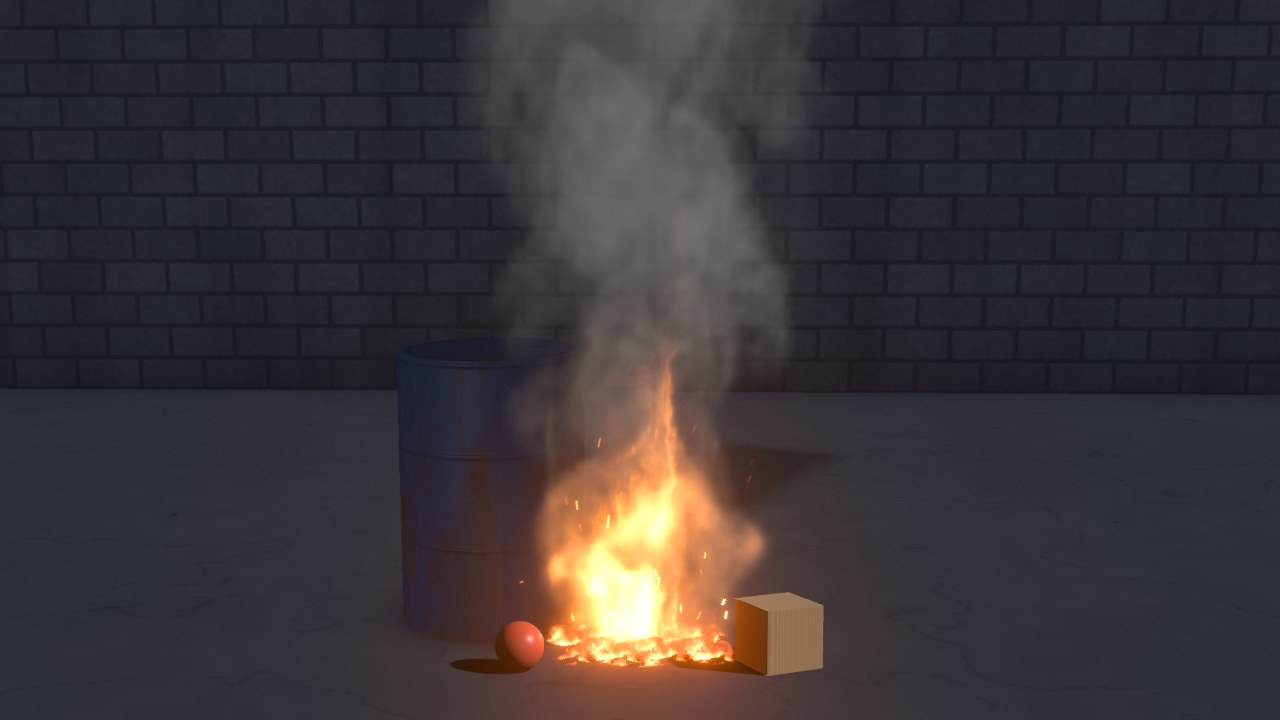
Any object (collider) can fall: it drops, tumbles, slides, bounces, stacks and knocks into other things, and the smoke, the water and the wind push it about. Turn on Falls in its Properties (Physics), or add one from the Things that fall group in Create. It works in every kind of scene: a crate dropped into a campfire, a boulder into a pond, a tower of blocks knocked down in an empty set.
Making something fall#
- Falls makes the object a free rigid body. Its keyframes now set only where it starts: from there it moves by itself.
- Falls from is when it is let go, in seconds from the first frame. Until then it is held where its keys put it, so it can be carried or lifted into place and then dropped. Negative values drop it during the pre-roll, so it has landed when the shot starts.
- Thrown at gives it a speed when it is let go (a thrown ball, a launched crate), and Spinning at a spin. One with moving keys also carries on at the speed its keys gave it.
- Material is what it is made of: how heavy, slippery and bouncy it is, and how it looks. Density, Friction and Bounce set their own values where you need them (0, or -1 for friction and bounce, uses the material's).
The Things that fall blocks are real size: a falling box, a bouncy ball, a 1 m boulder, a thrown steel ball, a steel drum, a domino run, a tower of blocks and a stack of crates.
Materials#
| Material | Density (kg/m³) | Friction | Bounce | Look |
|---|---|---|---|---|
| Wood (pine) | 550 | 0.45 | 0.35 | grain and knots |
| Stone (granite) | 2650 | 0.6 | 0.25 | speckled crystals |
| Concrete | 2400 | 0.65 | 0.2 | blotches and pores |
| Brick | 1900 | 0.6 | 0.15 | bricks and mortar |
| Steel, aluminium | 7850, 2700 | 0.45 | 0.45 | brushed metal |
| Glass, ice | 2500, 917 | 0.5, 0.05 | 0.5, 0.25 | clear: they refract what is behind them |
| Plastic, rubber | 950, 1100 | 0.35, 0.9 | 0.5, 0.8 | glossy, matte |
| Ceramic, cardboard, foam | 2300, 120, 40 | |||
| Painted metal, plaster wall, fabric, earth |
The numbers are handbook values. Friction is the Coulomb coefficient: a block on a slope slides once the slope is steeper than the angle whose tangent is its friction (24° for wood). Bounce is the share of its speed a thing keeps off a hard floor. A hollow everyday thing uses its weight over the space it takes up: a cardboard box 120 kg/m³, a crate of slats about 300.
What moves them#
- Each other and the ground. Things stack and stand in towers, slide and roll, and knock each other over. Objects that stay put hold them up; keyframed ones push them (a door swinging into a pile of boxes, a car through crates). A fixed mesh holds them on its real shape (things rest between the logs of a pile, on stairs); a falling mesh collides as its shape cut into convex parts, so a bowl or a cup holds what is put in it (one that is convex, or nearly, and an open mesh, one with holes in its surface, as its outline: its convex hull). It weighs what its own volume does, the shells it is modelled as counted once where they overlap. A hollow cylinder or ball that stays put (a barrel, a pipe, a tank) holds them in its walls, and its opening lets them in and out, a hatch a few centimetres across as well as an open top. An image heightfield is terrain they land and roll on.
- The air. The gas pushes them with its drag, measured around each one every frame: a blast blows light things away, a fire's updraft lifts paper, wind slides a cardboard box. They push the gas back as they move, as every moving object does: a falling crate shoves the smoke aside.
- Water. In a liquid scene they float or sink by their density, bob, drift with the flow and tip, as Floats objects do (Falls also lets them fall through the air first).
- Fire. A Burnable one with Spreading fire on catches where flames touch it and keeps burning as it tumbles: its fire is in its own frame.
- Cloth. They land on fabric and rest in it, and the fabric carries their weight: a crate dropped onto a sheet tied at its corners sags it and stays there, and a hammock holds what is put in it.
Things attached to a falling object (Attach to in the viewer's menus) go with it: a fire on a crate, a lamp on a swinging sign, the pins of a flag on a falling pole. An emitter tips over and tumbles with it, shape and jet: a flame jet on a toppling barrel keeps firing out of the barrel.
Breaking#
Breaks (Properties › Breaking) cuts an object beforehand into pieces glued together, which come apart where it is hit or loaded harder than it holds. A wall is knocked through, a pane shattered, a vase smashed, a crate splintered. A piece breaks away when something meets it faster than its material takes (glass and pottery about 2.5 m/s, brick 2, wood 7, steel 60), less so when what hits it is much lighter than it: the stone goes through the pane, a grain of sand does not. A joint also gives way when it is pulled apart harder than its strength over its area, sheared harder than that plus the friction of what presses it together, or bent past what its section holds. So a wall stands under its own weight, a soft knock cracks it, and a hard one brings it down, the bricks above the hole caving in; a vase tips off a table whole and shatters where it lands. In a thing broken into chunks, and in a mesh, each joint takes a share of a load as its glued area does, so where two chunks barely meet carries next to nothing, and a stone or concrete thing stands whole until it is hit. A mesh standing where it is is glued to the ground at its feet.
Where each thing is first hit is found by running the shot once with nothing breaking, and its cracks crowd round that spot: small chips where it is hit, larger pieces further off, as real breaks go. A crack runs on from where it is hit as far as the material lets it: glass and pottery shatter right through (the glass round a stone's hole cracks to the frame and stays in it), stone and brick less, wood splits off where it is hit, metal not at all. Until its first crack opens it is drawn whole, without seams (a brick wall shows its joints, and a burning thing its pieces).
Metal and plastic bend before they break: loaded past their yield, their joints take the bend they are forced into and keep it, so a post hit by a wrecking ball folds over and stays folded, a sheet-metal box crumples, and a joint tears only once it has bent too far.
- Breaks into:
- Chunks: stone, concrete, pottery.
- Bricks: a box laid as bricks in running bond, held by mortar.
- Shards: glass, slivers radiating from where it is hit.
- Splinters: wood, pieces long along the grain.
- Bends (metal): where metal or plastic creases: a bar or a post along its length, a sheet across it.
- Pieces: how many (more take longer to simulate).
- Strength scales how strongly the pieces hold.
- Held by: what holds one that does not fall: glued to the ground along its base (a wall), held round its edges (a pane in its frame), or nothing.
- A mesh breaks too: its pieces are cut from its inside, crowded where it is hit.
- A hollow object (Hollow above 0) breaks as a shell: a vase into curved shards of its wall (taller than wide, as cracks run up a pot) and pieces of its base, a crate wall by wall. A hollow cylinder is closed at the top unless an opening takes its top off (a pot: Opening size wider than it, across its top).
- With Falls on too, it falls whole until it hits something hard enough: a dropped vase shatters, a thrown crate splinters.
Broken faces show the material's inside: raw brick, pale wood, the green edge of glass. Where it breaks it throws up dust, as much as the material holds (mortar, plaster and soil most, glass hardly any), in the smoke's colour (Shading › Smoke colour: a pale brown for dust). Hundreds of pieces are drawn, shadowed, hide the fire and the liquid behind them, and the gas and the water flow round them and are pushed by them.
The Things that fall blocks include a brick wall, a glass pane in its frame, a concrete pillar, a wooden crate that splinters and a vase. Presets: Ball through a brick wall, Stone through a window, Vase off a table.
Breaking and burning#
An object that both Breaks and is Burnable (with Spreading fire on) burns piece by piece. Wood burns as wood does (engine/wood_fire.py), each kind by its own figures, spot by spot over the surface of each of its pieces (a grid of spots on each face, where the fire's heat on it is felt): its char starts where the flames touch it and spreads from there, across the seams between its pieces, rather than a whole board darkening at once. A face glued to the next piece is inside the wood and does not burn until the pieces come apart.
- It catches where enough heat reaches it. The flames and hot smoke next to a piece heat its surface, by convection and by their soot's radiation (about 40–50 kW/m² in the flames). It catches when its surface has reached its piloted ignition temperature (about 320 °C for pine, 350 °C for oak), which under a steady heat takes as long as its thermal inertia says: about five seconds in the flames for pine, a minute in 20 kW/m², and never below about 12 kW/m², where the heat leaks away as fast as it comes. Hot smoke trapped under a roof can bring a whole room to that (flashover).
- Fire climbs fast and creeps slowly. The flames over a burning patch heat the wood above it, so fire runs up a wall and along the underside of a roof, while it creeps over wood sideways at about a millimetre a second and downward a third as fast (slower over denser wood).
- It chars. Burning, it chars at its charring rate (0.65 mm a minute for softwoods, 0.5 for hardwoods, as Eurocode 5 has them; faster in more heat), from whichever of its faces burn, and gives off heat fiercest as it catches, falling to about 0.4 of that as its char thickens, as wood does in a cone calorimeter. It is charred through where its char from one face and the other add up to its thickness: a 19 mm board burning on one side, as a wall does from inside, takes about half an hour in the flames, one burning on both half that.
- Its flames go out where too little heat reaches it (a lone board), leaving glowing char that can catch again. Charred through, it is spent, its char showing on both faces: it glows, dims and mostly crumbles to ash, while some stays as black charcoal.
- It weakens as it chars. The glue between two pieces is as strong as what is left of the more charred one lets it be (its spots' char, on its open faces), so a burning structure sags and falls in: a post charred through at its foot topples, and a shed's walls give way. A piece most of whose surface is charred through is spent: it glows and crumbles to ash.
On the stage, wood that heats browns, then chars black and cracks into blocks as its char shrinks (alligatoring), the blocks growing as the char deepens, its cracks glowing orange in patches where it burns hardest and a dull red as it cools; spent char greys with ash where it faces up. Its char front is ragged, and runs on across the seams between its boards as the flames do, rather than stepping at each one.
Real wood burns slowly: a shed takes minutes to catch all over and tens of minutes to char through. Spreading fire › Burn speed-up runs the wood's burning that many times faster than real while the flames and the smoke move at their own speed, a time-lapse of a building burning down. Keyframe it to let the fire grow at its own pace and then speed through the burning down. (Other burnable things, and the ground, go by Spreading fire's Catch time, Creep speed and Burn time.)
Preset: Shed on fire, a pile of rubbish burning in the back corner of a pine shed, its posts, walls, door header and roof all breakable and burnable: it climbs the corner, flashes over under the roof, burns all over, chars through and falls in, 8 times faster than real, then 200 times.
Joints and ropes#
Joined by (Properties › Joint) holds an object to another object or to a fixed point. An object with a joint falls (it needs no Falls). An object can have more than one joint: a plank seat on two ropes, a plank of a rope bridge tied to the planks either side of it, a lid on a hinge with a spring to hold it up. On an object that has a joint, Hang it on another rope and Tie it with another rope to (and Hinge it to) in the viewer's menus add one beside it: its further joints are its More joints, each with the same settings as the first (Joined by, Joined to, Joint on it and the rest), and any it does not give its own are the first's. A second rope or spring goes from the other end of its longest side from its last one (one tied at its middle is moved to one end), a third from a free corner, each tied straight above on what it hangs from. Setting Joined by to Nothing takes them all off; only the first has a keyed Motor speed (a further hinge turns at the speed it gives, if any).
- A rope holds it at its length: it hangs and swings, goes slack when it is thrown up or knocked toward where it hangs from, and is caught again with a jolt. Rope length is how long it is (0: as long as it is at the start). Rope is draws it as a rope or a steel cable, hanging in a curve when it is slack, and Thickness is how thick. A rope goes over the posts and balls in its way that it hangs over (fixed or keyed cylinders lying about level, and balls, between its ends and above it, that it is long enough to reach over, taut, but not one it is tied right against), as many as it meets, sliding over them as over a pulley: thrown over a beam, a crate hangs from it and swings under it, the rope drawn over the top; over two bars, a counterweight on one side lifts a crate on the other. It swings past a post beside it or a bar under it, through them. Goes over names the posts it goes round, in order from the object (separated by commas), when it should not find them itself, and none keeps it off them all. Tied at its middle, it is tied where the object faces the first post it goes over, so a crate hangs level under its pulley.
- A rope with weight (Has weight) is links of rope, as a chain is links of steel: a 25 mm rope weighs about 0.4 kg a metre, a 10 mm steel cable as much. It hangs in its own curve, drapes over and catches on whatever it meets (not only round posts and balls) and lies over what it goes over with the friction of rope on wood, so it holds on a post where a weightless one would slide.
- A chain (Rope is › Chain) is steel links that are links: it weighs what a chain of its Thickness does (12 mm: about 3 kg a metre), hangs in its own curve, catches on and drapes over what it meets and piles up where it lands, and holds what hangs from it, a couple of hundred kilograms on a 12 mm chain. A chain and a rope with weight give way at the object they hold when they are pulled there harder than Breaks at, and go on hanging from where they are tied.
- A spring pulls it back toward its length at rest (Rope length) with Spring stiffness newtons for every metre it is stretched. A weight on a spring bounces with the period 2π√(m/k) and settles stretched by its weight over the stiffness.
- A hinge lets it turn about one line only (Hinge axis, in its own frame, through Joint on it): a door, a gate, a lid, a seesaw, a wheel on its axle.
- A ball joint lets it turn any way about one point (Joint on it): a pendulum on a rod, a sign hanging from a bracket.
Where it is held:
- Joined to is the name of the object at the other end: a beam, a crane's jib, a moving arm it is carried by, or another falling thing (two crates tied together). Empty, it hangs from Anchor, a fixed point.
- Joint on it is where it is held, in its own frame ((0, 0, 0) is its middle). A rope or a spring held at its middle is tied where its surface faces the other end: the top of a ball hanging from above. Joint on the other is where the rope or the spring is tied on the object it is joined to.
- A hinged or ball-jointed object spins about its joint when it is given Spinning at: a door pushed open turns about its hinges.
- Joint friction slows a hinge or a ball joint down: at 0 it swings for ever, at 0.5 a door settles in a couple of seconds.
- Breaks at is the force it gives way at. A rope snaps when it is jerked harder than that (a weight that falls before its rope catches it pulls several times its weight), and a hinge tears out of a door too heavy for it.
The Ropes and hinges blocks are a wrecking ball on a crane, a rope swing, a swing on two ropes (a plank seat that stays level from end to end), a counterweight that lifts a crate on a rope over two pulleys, a rope bridge of six planks each tied to the next by two ropes (it sags about a thirteenth of its span), a door on hinges in its frame, a hanging lamp (its light swings with it), a weight on a spring and a seesaw that flips a ball into the air. Preset: Wrecking ball, through a brick wall.
People and cars#
Build (Properties › Physics) makes an object a thing of many parts on joints, in its box, all one object in the scene:
- A person: a crash-test figure, 1.8 m in a box of 0.5 × 1.8 × 0.3 m (its Size scales it), about 80 kg. Its parts (head, chest, pelvis, upper arms, forearms, thighs, shins, feet) turn on ball joints and hinges within a body's reach: a knee bends only back, an elbow only forward. Stance › Stands braced: it stands on its feet, braced, until something hits it hard (faster than 1.5 m/s), and then it goes limp and falls as a body does, over a car's bonnet or down the stairs. Limp: it falls from the start.
- A car: 4.4 m in a box of 4.4 × 1.5 × 1.8 m, about 1300 kg, its body, its tinted glass and four tyres on springs (they sink 6 cm under its weight and soak up bumps). Drive drives its rear wheels, all four, or none (it rolls, pushed or down a slope); Speed is the speed its motor holds (keyframe it; 0 brakes it, below 0 reverses), as far as the tyres' grip and a car's torque allow, and Steer turns its front wheels (left is positive; keyframe it). It drives over grass, leaving its tracks flattened, knocks walls down and carries a person on its bonnet.
Their parts are drawn in the object's material (a car's in its colour, its tyres black rubber, its cabin tinted glass), the smoke and water flow round them, and sand and snow are pushed aside by them. Blocks: People and cars in Create.
Explosions#
An emitter's Blast (in its Motion settings) is an explosive charge, in kilograms of TNT, that goes off when the emitter ignites (Ignite at). Its blast wave throws every object that falls away from it, at the speed its impulse gives the object: the impulse on the face toward it, falling off as one over the distance and growing as the charge to the power two-thirds. A kilogram a metre off gives 400 Pa s (the shock's impulse, doubled as it reflects), enough to throw a 40 cm wooden crate at 5 m/s. Breakable things are blown apart: each piece takes its own push, and the joints between pieces thrown apart break. Sand, snow, mud, jelly and clay are thrown too (Sand, snow and mud). The emitter's own burst (Fuel, Temperature, Burst speed) makes the fireball and the smoke.
The Explosion block in Create › Fire is a 2 kg charge with its fireball. Preset: Blast in a yard.
In the viewer each charge is marked where it is, as a burst the size of its fireball, bright as it goes off, with its weight and the frame it goes off on.
Lightning#
A light of the Lightning kind is a bolt from its Position to where it Strikes. Its channel is jagged at every scale, as real lightning is (about 1.4 times as long as the straight line), with branches that light up only in its first flash. It flashes a few times down the same channel (Flashes: its return strokes, tens of milliseconds apart, each fading in about 20 ms). Its core glows white-hot, with a halo in the air round it, and through the flash it lights the set and the smoke like a row of lamps down its channel (Intensity). Where it strikes it starts a fire (Sets fire where it strikes), which catches whatever will burn there when Spreading fire is on. Branches, Thickness and Bolt seed shape it.
The Lightning block is in Create › Lights. In the viewer its channel is drawn from where it starts to where it strikes; select it and drag the diamond at the bottom over the ground to choose where it strikes. Preset: Lightning strikes a post.
Lightning is drawn on the stage, so in sky scenes, where there is no stage, it does not show yet.
Tilted objects#
Tilt and Roll (Properties › Shape) tip an object over, after its Rotation about the vertical. Tilt leans its top toward its front (it turns about its own sideways axis); Roll leans its top to its left (about its own front-to-back axis). A plank tilted 20° is a ramp; a wall can lean, a wheel lie on its side or stand on its rim. Everything meets it at its slope: smoke slides up its underside, water runs down it, sand piles on it, cloth drapes over it, and a falling thing slides down it if the slope is steeper than its friction angle (a wooden box on a wooden plank: past 24°) and stays put if not. Keyframe Tilt or Roll to tip a tray or flip a flap: what is on it is thrown by its turning.
The Ramp block (Create › Objects) is a 2 m plank propped up at 20°. Ball down a ramp (Things that fall) rolls a steel ball down one into a row of dominoes.
Motors#
A hinge with a Motor speed (Properties › Joint, in turns a minute) is driven round at that speed: anticlockwise looking down its Hinge axis from its tip (negative: the other way). Motor strength is the most turning force the motor has, in newton metres. The motor gets up to speed as fast as that can turn what it drives, and holds the speed against the load; a load too much for it (an arm too heavy to lift, a cart on too steep a slope) stalls it. The motor pushes back on what it is joined to: four wheels hinged to a cart drive the cart along, and a fan on a fixed post just turns. Keyframe Motor speed to start, speed up or stop it: keyed down to 0, it brakes.
The Machines blocks (Create › Machines) are a motor cart (four rubber wheels at 30 turns a minute: it drives off at half a metre a second), a turntable that spins up until the blocks on it fly off, and a windmill whose sails stir the smoke. Preset: Cart off a ramp, a burning cart that jumps a ramp into a tower of blocks.
Heat#
Every object has a temperature (Properties › Heat › Temperature: how hot it is as it starts) and warms and cools as the real thing would, by what it is made of and how big it is. A steel bar held in a fire's plume heats through in minutes and glows; a log's skin scorches in seconds while its heart stays cold; a red-hot steel ball dropped in water boils the water round it, held off by a film of its own steam at first, and cools to black. An object takes heat from:
- the air, or the fire's gas next to it, faster where the gas moves past it;
- radiation: the fire's, glowing matter's, lava's and other hot objects', absorbed as well as its surface radiates (oxidised steel well, bare aluminium hardly). One list of what radiates serves objects, cloth and matter alike;
- what it touches: the ground (as the floor's material takes heat: concrete faster than wooden boards), other objects (a pan on a hot plate), water (with Liquid › Heat and phase changes on, through the boiling curve), lava, and wax, chocolate, metal, sand and snow;
and gives it back the same ways: it radiates, heats the air next to it (a shimmering plume rises off a hot bar and lights what burns above it), and warms or chills what touches it. Its surface and its inside each have a temperature: steel's even out within seconds, a log's or a brick's slowly.
Keeps its temperature holds an object at its Temperature, as something the shot does not show would: a hot plate on its element, a stove, ground frozen hard. It still heats and chills what meets it. Scenes saved before objects warmed and cooled open with it on for every object whose Temperature is not 20 °C, so they behave as they did.
Hot, an object glows as a blackbody at its surface's temperature, dull red at about 500 °C, orange by 1000 °C, as bright as its emissivity lets it, and its glow lights what is round it. It is as bright as a flame that hot would be (Shading › Emission, Fire exposure, Physical brightness), as hot metal and lava are: in a shot with no fire, raise Fire exposure until it reads against the room's light (Red-hot steel quenched uses +3.5 in a dim workshop). Heat runs as fast as it really does, times Domain › Heat speed (as for wax, chocolate and metal): 4 unless set. Preset: Red-hot steel quenched (Ice and steam).
How they look#
Without footage, objects are drawn in CG in their materials (wood, stone, brick and so on), lit in the same light as the smoke: the key light with soft shadows, the sky (darker in corners and under things), the fire's own light with shadows, and the lights in the set. Glass and ice are clear: you see the fire and the set through them, bent, and the sky in them. Own colour draws one in a colour of its own. What fire does to a burnable object shows: it browns as it heats, blackens as it burns, with embers glowing in its char, then greys with ash and dies down to a dull red smoulder. The floor where it has burnt (Spreading fire, Ground) blackens the same way.
Behind them is the stage (Composite › No footage): a floor out to the horizon under a sky in the ambient light of Lighting (or the environment HDRI), or a flat background colour. Floor is what the floor is made of: studio grey, concrete, wooden boards, tiles, dirt, grass, sand or a 1 m checker for judging scale. The fire lights the floor and the objects around it, and smoke shades them. Presets keep the flat background they were made on; set Backdrop to Floor and sky to put them on the stage.
In your footage#
Look says how an object is drawn: CG, In the footage, or Automatic. Automatic is CG without footage, and with footage for things that fall or float (they cannot be in your footage). An object In the footage stands in for the real thing in the shot: it is not drawn, but it hides the fire behind it, and the CG objects behind it.
CG objects go over the footage lit by the shot's light, and their shadows darken the footage where they fall on the ground or on an object in the footage. The footage's depth pass and matte hide them behind the real things in the shot.
Limits#
- An object's heat is two temperatures, its surface's and its inside's, each one all over: a bar held in a fire by one end warms along its whole length, and glows evenly.
-
Objects meet the ground and each other where their surfaces come within 6 mm; a mesh meets them, and the air and the radiation, by its bounding box.
-
A scene holds up to 16 objects in all, falling or not (a broken one's pieces do not count: there can be hundreds).
- A broken mesh's pieces are convex, so a hollow or a dent in one is filled in (whole, it is drawn as itself).
- A weightless rope or steel cable goes round cylinders and spheres only (up to 8, frictionless, as pulleys), not boxes or meshes or hollow things, and passes through anything else. Found by itself, it goes only over those it hangs over (the side it goes round faces at most 60 degrees from straight up), so it passes through a bar above it where it runs steeper than 60 degrees unless the bar is named in Goes over (a hoist, its rope tied off above the pulley to one side, is such a case), and it never finds by itself a falling one or a bar sloping more than 15 degrees. Named, those are gone round, but MuJoCo takes a cylinder as endless, so a rope can slide off the end of a sloping bar, and the side a falling one is gone round turns with it: either can fling what hangs on the rope. One named that it goes round beside or under it is held round that side, and swung across the post it can jump round it and fling what hangs on it (MuJoCo wraps a rope round the named side wherever its straight line passes the post). It is drawn straight between the posts it goes round, taut, even while it is slack. A rope with weight catches on everything but is at most 60 links long (on a long thin rope each link is longer than it is thick), and a chain or a rope with weight gives way only where it is tied to the object. The viewer draws only an object's first joint before the shot is simulated, and More joints are made by joining it again, not edited in Properties.
- A person's and a car's parts are rigid: a car crumples only as far as its body is one piece (it does not dent), and a person does not grab or step.
- The strengths are effective ones, set so that things hold and give way under steady loads as they look like they should (pottery's and glass's near a handbook's, the rest lower); hits break things by their speed (above).
- A falling mesh collides as up to 128 convex parts cut on a grid 32 cells across it: its hollows and dents are kept to within about half a cell (4 mm on a 30 cm bowl), a hollow or a dent smaller than a cell or two is filled in, and a mesh too intricate for 128 parts has some of its smaller hollows filled in (the viewer's notices say which). Cutting one takes about half a second to a second the first time it is simulated (a 30 cm bowl of 5,000 triangles 0.6 s, of 100,000 triangles 1.1 s and about 120 MB), and its parts are kept with the baked meshes for next time. A mesh that fills its hull all but 3%, and an open mesh, fall as their convex hull. A hollow mesh that stays put is not in the rigid world (only its walls are, for the smoke and the water), and a hollow thing that falls falls as a solid one of its weight.
- A hollow cylinder's or ball's opening is cut out of its walls in tiles down to a quarter of its size (1 cm at least), so its edge is ragged by up to half a tile: a small hatch is mostly open (8 cm across in the top of a 1 m tank 95%, 10 cm in its side 70%), and the wall beside it is open a little past its edge.
- Contacts are slightly soft, so bounces are within about 0.05 of a material's bounce, and the least a thing bounces is about 0.2. Things that start inside each other are thrown apart when they are let go (the viewer's notices say which).
- In a liquid scene with grey stand-ins (Water › Colliders), things that fall or float are drawn as stand-ins in their material's colour.
- A motor holds its speed, not its angle: things on separate motors drift a little out of step when their loads differ. Give one balanced part one motor (the windmill's sails are two bars crossed on its hub).
- An emitter attached to a fixed object keeps its own turn (only fire shaped like the object, such as burning letters, tips with it); one on a falling object turns with it whichever way it tumbles. The pins of a fabric on a falling object still turn only about the vertical.
- Things that fall come to rest on cloth but do not bounce off it (a trampoline does not throw a ball back up): the two meet once a frame, the things against the cloth as it was at the frame's start. A broken object's pieces pass through cloth. A falling mesh meets it by its convex parts (cloth lies in a bowl), a little short of their edges and corners.
Under the hood, MuJoCo (Apache-2.0) integrates the bodies: their contacts, friction and stacking, with the time step their size needs. The gas, the water and the cloth see them as moving objects every substep. In each of their steps the cloth's vertices, as they were at the frame's start, hold them off with a stiff, damped contact (by their mass and their bounce), and the cloth takes what it gave them in the same frame, with their weight's worth of mass riding on it.
Something wrong or missing on this page? Edit it on GitHub.