 Blackbody
Wood#
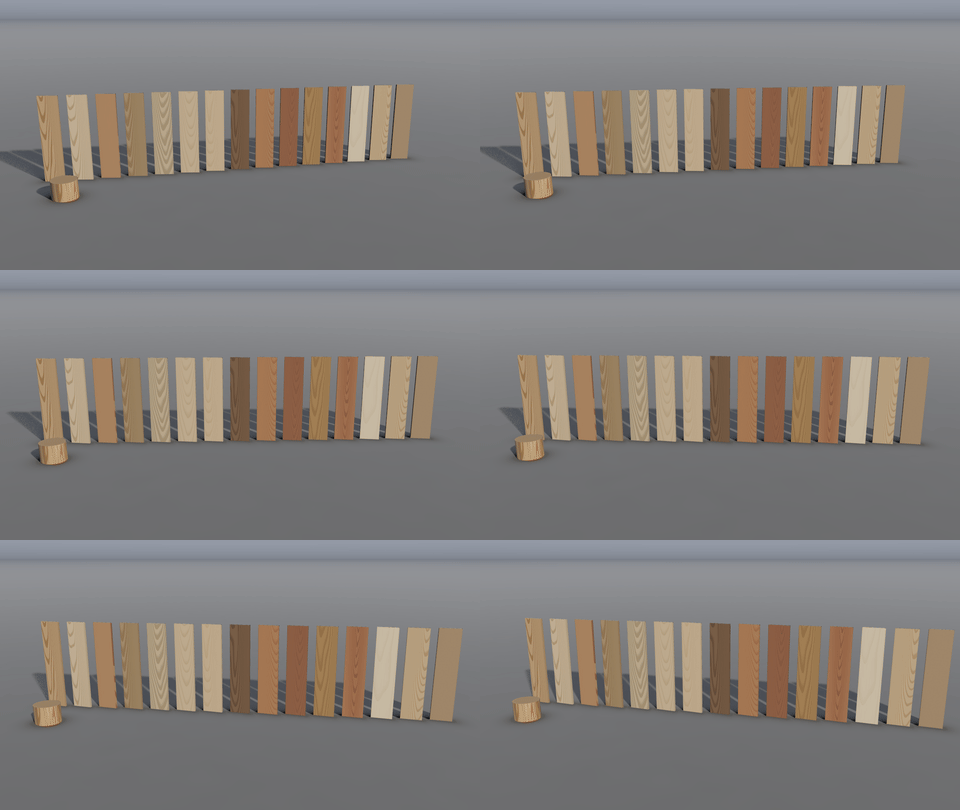
Wood is fifteen materials: pine (Wood), spruce, Douglas fir, oak, ash, maple, birch, walnut, cherry, mahogany, teak, cedar and balsa, and two made from wood, plywood and MDF. Each is its own wood all through: its density, how stiff and how strong it is along its grain and across it (from the USDA Wood Handbook), and how it looks.
How it looks#
A trunk grows a ring a year round its pith: pale earlywood in spring, darker, denser latewood in summer, then the next ring starts at once. The stage draws that, solid through the object, so a cut, a break or a bullet's hole shows the same wood inside:
- Grain. A board's grain runs along its longest side (a log's along its axis). A board is sawn from the trunk off its middle and a little off its axis, so its wide face cuts the rings at a slant: flat-sawn boards show long nested arches ("cathedrals"), quarter-sawn ones (about one in four) straight lines; its edge shows straight lines, its end arcs of rings round a pith off to one side.
- Rings wander (no trunk is round) and widen and narrow year by year; softwoods (pine, spruce, fir, cedar) turn abruptly from earlywood to latewood, hardwoods gradually.
- Knots, where branches grew out of the pith: dark ovals with rings of their own, the grain swirling round them (pine has the most).
- Pores and rays: oak and ash have rows of open vessels in their earlywood, dark dashes along the grain; oak's broad rays show as silvery flecks where a face cuts them square. Maple and walnut have figure, a ripple in the grain's sheen.
- Heartwood near the pith is darker than the sapwood outside it. End grain is darker and rougher.
- Plywood's edges show its plies, light and dark with glue lines between; MDF is a felt of fibres, no grain at all.
Pick one in an object's Material; Own colour stains it (the grain stays).
How it breaks#
Wood is strong along its grain and weak across it, and splits along it far more easily than it breaks across it. Made breakable (Breaks into: Splinters, which is what a wooden object gets), it is cut along its grain into bundles of fibres, and each bundle into lengths, the cuts between lengths staggered from bundle to bundle and slanted. Lengths of a bundle hold each other as the fibres do; bundles side by side hold each other as the wood does across its grain, less the wider their face (a split runs as a crack). So:
- It bends before it breaks, as stiff as its wood is (its stiffness along the grain, from the handbook): a 2 m pine plank, 19 x 140 mm, sags about 2.5 cm under 10 kg in its middle and 5 cm under 20 kg, as beam theory has it, and holds; a short board is all but rigid, as it is.
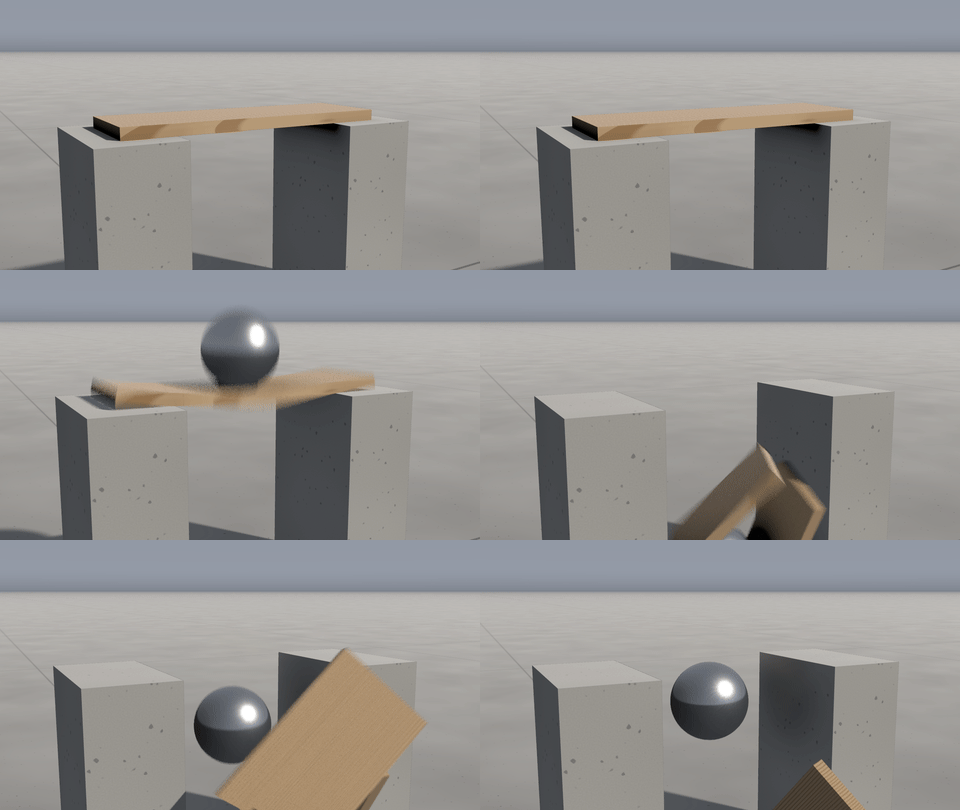
- It is as strong as a sawn board is rated (about half the clear wood's strength in the handbook, for its knots and its grain's slope). A board bent until it breaks does not snap square: its bundles break one by one at their own weak points along it and peel apart along the grain, a jagged greenstick break with splinters standing out of both halves. A 19 mm pine board on a 30 cm span shrugs off a kilogram dropped on it and snaps in two under 5 kg dropped half a metre; oak takes more, balsa less. The plank above breaks if 40 kg is dropped on it.
- A log (a cylinder) is cut into wedges round its pith, in lengths: it checks and splits along its rays.
- An edge driven into its end grain splits it along the grain, in the plane of the edge, as an axe or a wedge does: the blow's energy runs the split as far down the grain as it pays for (wood takes about 800 J a square metre to split, the wedge's friction in the cleft included), and the edge's faces push the halves apart. A 3 kg wedge at 8 m/s (about 100 J, an axe's blow) splits a 24 cm round of pine 40 cm long in two; at 3 m/s it only checks its top. Any free object meeting the end grain on an edge or a corner of a box does it (a wedge, an axe's head, a falling crate's corner); one landing flat on it bounces, as a mallet does.
- A bullet holes a board going in and tears a split out of its back along the grain, splinters flying (see Bullets).
- It burns as wood does (Burnable), floats as its density says (balsa high, oak low).
Presets#
- Breaking a board: a 10 kg weight dropped from a metre onto a pine board across two blocks, slowed down four times.
- Bullets through boards: a 9 mm pistol and a .308 rifle into six pine boards stood 2.5 cm apart: the pistol slows through each and only just gets through the last, the rifle goes through all six, hardly slowed.
- Woods: every wood side by side, as boards and as logs.
Limits#
- An edge splits wood only as a box's edge or corner: a blade modelled as a curved mesh bounces off the end grain.
- The bend is the plank's whole bend, joint by joint along it: wood does not stay bent once the load is off (it does not creep).
Something wrong or missing on this page? Edit it on GitHub.